Decoding of markings of e-ink screens
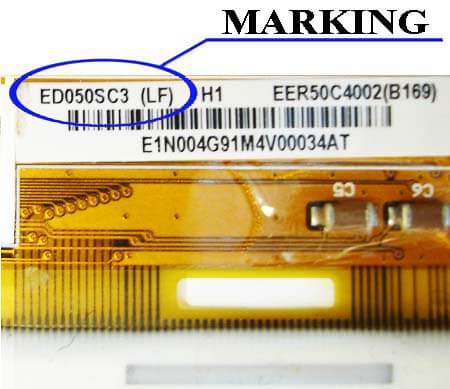
There is an alphanumeric marking of the model on a flexible cable. From this information you can learn the manufacturer and some parameters. Let's analyze the marking in detail.
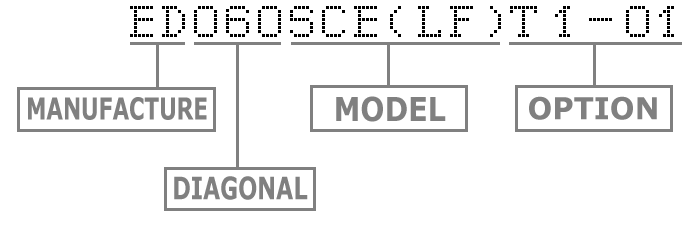
The first letters of the marking contain the information about the manufacturer of the display:
- letters ED - E-ink Corporation;
- letters LB - LG DisplayCompany;
- letters OPM - OED Technologies CO., LTD.;
- letter A - Sipix Imaging Inc.
You can learn more about manufacturers of e-ink displays
here.
The numbers which are after the letters mean the size of diagonal of the screen:
- 043 - 4,3 inches;
- 050 - 5 inches;
- 060 - 6 inches;
- 068 - 6,8 inches;
- 080 - 8 inches;
- 097 - 9,7 inches;
Then there are letters and numbers which mean the name of the model, for example, SCE(LF). This name, unfortuntely, can not be decoded. Different models of screens have different resolution, way of producing and construction of socket of the flexible cable.
After the name of the model there can be some more letters and numbers. We have named them "option". This symbols are probably technological information of the manufacturer (batch number etc.). They do not influence the functions of the display.
Be attentive when you order a new screen as displays with additional functions of backlight and sensor have the same markings as displays without these functions. The only difference is the appearance - the number of flexible cables. Compare the photo in the site of the shop with the screen of your e-book.
Back


What to read?
Cecelia Ahern "Thanks for the Memories". A blood transfusion saves Joyce Conway’s life. After she wakes up, she finds that she has memories and knowledge that she did not possess before her accident. As she deals with her impending divorce and a miscarriage, Joyce encounters a handsome American, Justin. Joyce and Justin are drawn to each other. What is this magical connection?...
What to read?
Sergey Dyachenko, Marina Dyachenko "The Scar". Reaching far beyond sword and sorcery, The Scar is a story of two people torn by disaster, their descent into despair, and their reemergence through love and courage. Sergey and Marina Dyachenko mix dramatic scenes with romance, action and wit, in a style both direct and lyrical. Written with a sure artistic hand, The Scar is the story of a man driven by his own feverish demons to find redemption and the woman who just might save him. Egert is a brash, confident member of the elite guards and an egotistical philanderer. But after he kills an innocent student in a duel, a mysterious man known as "The Wanderer" challenges Egert and slashes his face with his sword, leaving Egert with a scar that comes to symbolize his cowardice. Unable to end his suffering by his own hand, Egert embarks on an odyssey to undo the curse and the horrible damage he has caused, which can only be repaired by a painful journey down a long and harrowing path...
Cecelia Ahern "The Time of My Life". Lucy Silchester keeps receiving this strange appointment card and sweeping its gold embossed envelope under the rug. Literally. She busies herself with a job she doesn't like, helping out friends, fixing her car, feeding her cat, and devoting her time to her family’s dramas. But Lucy is about to find out that this is one appointment she can’t miss, when Life shows up at her door, in the form of a sloppy but determined man...
To find these books, check out the "e-library".